education, workshop
Gairdin: Traditional Slovenian Houses - Reinvented
Ana Farič
May 08, 2026
We learn from our experiences. :) Our recent adventure, in which we bravely introduced classification trees to 1st-graders, showed us that even the youngest students can easily engage with complex ideas. The key is to adapt activities to their age and abilities.
During the workshop with the youngest students at Prežihov Voranc Primary School, we confirmed something we have observed for quite some time:
- Working with physical materials is highly motivating. It encourages creativity, resourcefulness, and a positive attitude toward learning.
- Through teamwork and friendly competition, all students become engaged in the activity, stay focused, and support one another.
- Rather than introducing concepts frontally, we allow students to discover key ideas through games, challenges, and hands-on tasks. As a result, they remember what they learn, and can generalize their knowledge.
- When an activity includes all these elements, using a computer becomes the icing on the cake. When we demonstrate how a computer approaches the same task, students understand it and begin asking fascinating questions.
With these observations in mind, we decided to redesign the activity about Traditional Slovenian Houses. Previously, students received cards showing different houses, sorted them into groups, and entered the data into a computer. This time, we transformed the activity so that no computer was needed at all.
We tested the new version with 5th-graders at Alojzij Šuštar Primary School. In addition to the house cards, groups received maps and tables containing locations of the houses. After sorting them, students marked the corresponding group for each house in their tables and searched for the houses on the map. Some locations could be found simply by looking up the place name, while other required students to work with coordinates.
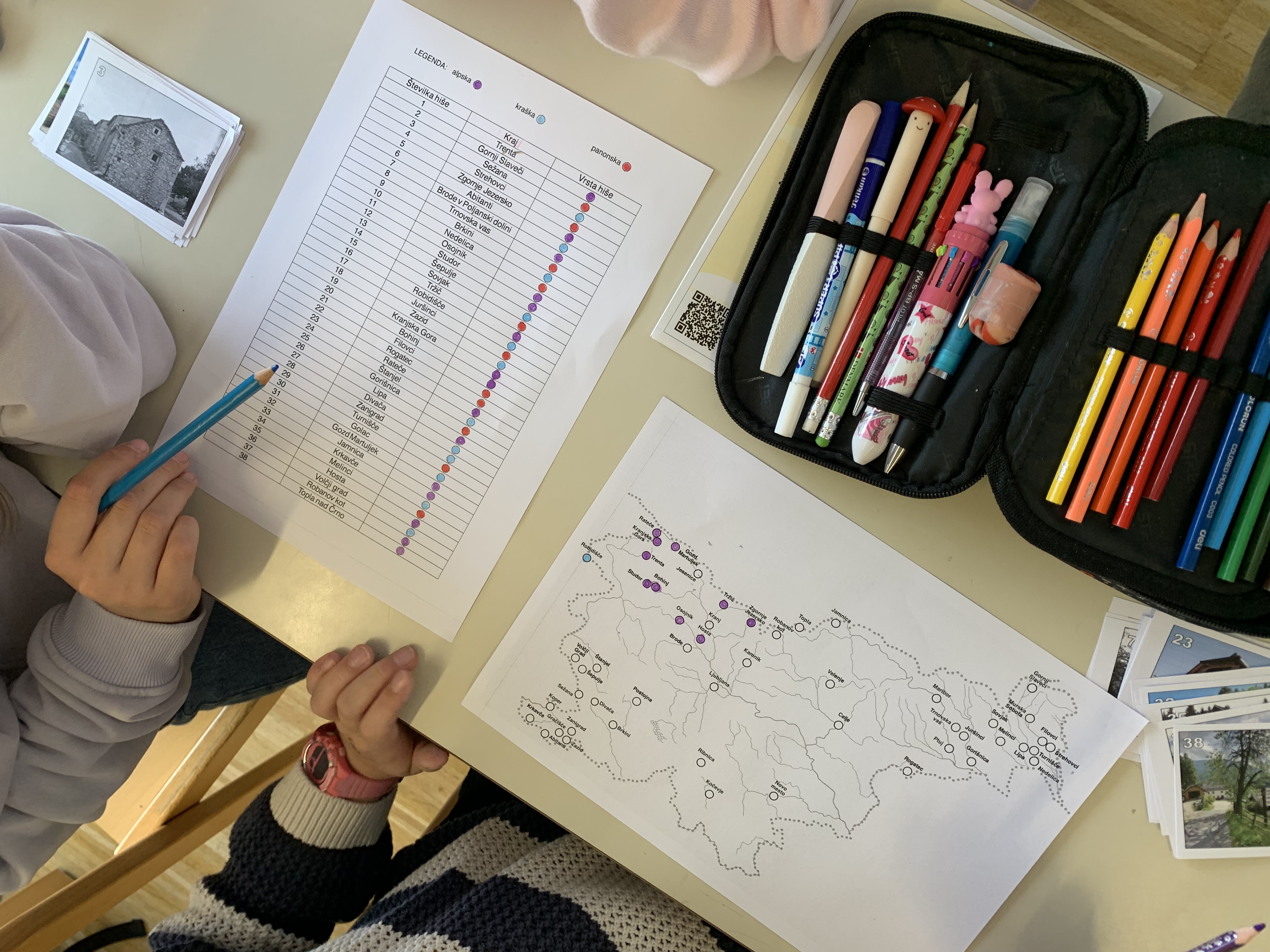
Once groups had completed their maps, we placed a larger one on the board and invited students to come forward and use magnets to indicate the locations of individual houses.
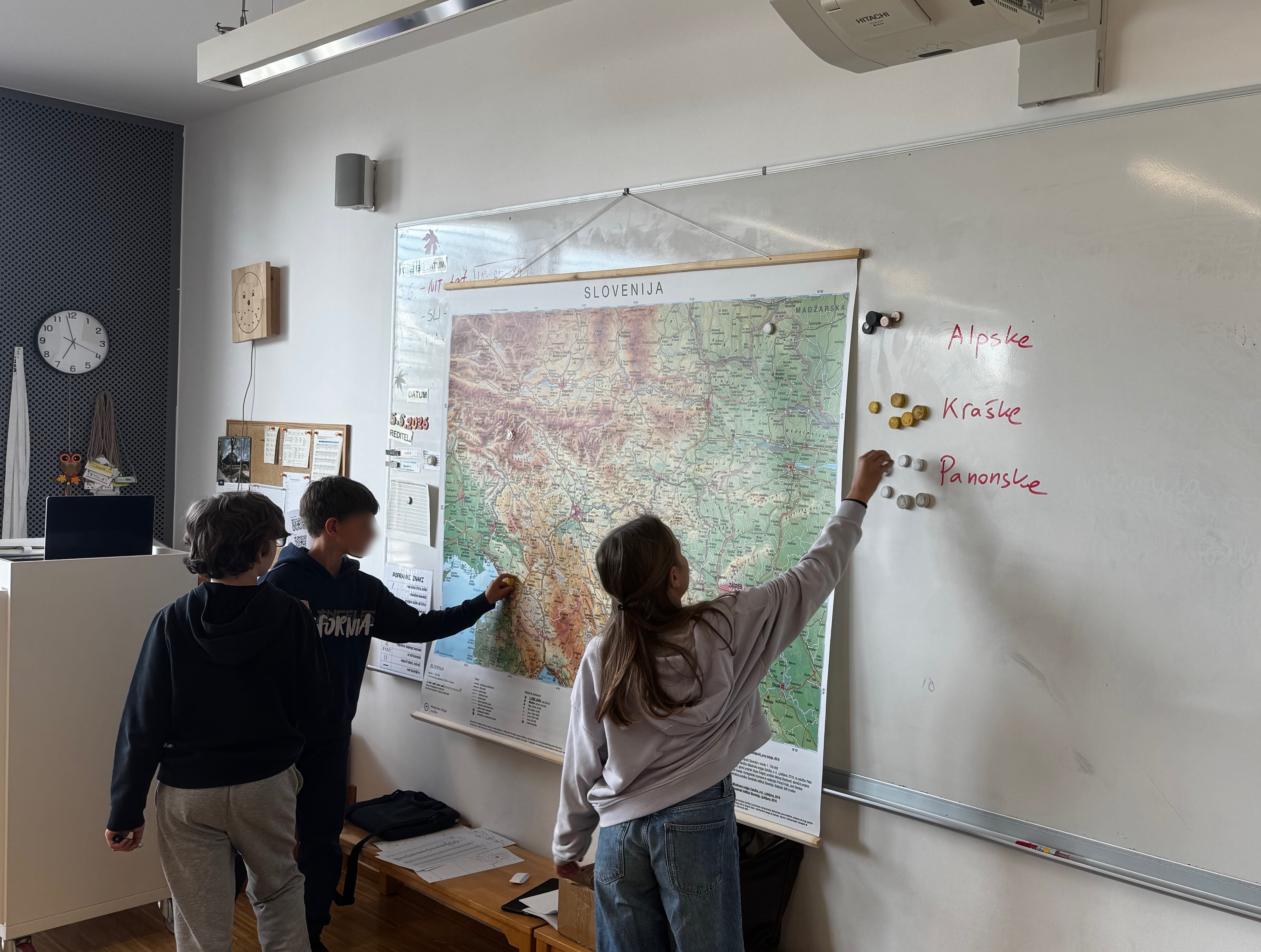
At the end of the lesson, we asked every student to share their thoughts. They told us that they enjoyed this way of learning because it was “different than usual.” They had fun searching for and classifying houses, and many were curious to see how a computer would solve the same task. We will definitely have to return and explore that question together. :)
A detailed description of this activity, along with many others, can be found on the Gairdin website.